
Request Sea Duty Only | Lt. Joseph F. Anderson
On December 13, 1941, six days after Pearl Harbor, two men in their seventies appeared before the probate judge of Edgefield County, South Carolina. W. E. Lott and J. H. Allen were neighbors of the Anderson family. They swore that to their own knowledge, on or about October 16, 1917, Lora Waldrep Anderson had given birth to a son in Edgefield, and that his name was Joseph Fletcher Anderson.
No birth certificate had been filed when he was born. He needed one now.
That week, three men in Edgefield wrote letters on his behalf. The county treasurer, J. L. Prince, had known him all his life. “He is of a very good family,” Prince wrote. “He has a fine character, is honest, intelligent, sober and is a gentleman.” The probate judge, O. D. Lamb, noted that he was a graduate of Clemson College and a former member of the Spartanburg High School faculty. J. A. Lott wrote that the previous summer, Joe Anderson had run for County Superintendent of Education and won, over two opponents.
He was 24. He had held the office since July. His aunt, Erin Waldrep, had been his guardian before he came of age, and hers was the name he gave the Navy as next of kin.
On December 18, he enlisted in the Naval Reserve in Columbia.
Four Chiefs
He was classified as a candidate for an officer’s commission and called up the following spring. On May 11, 1942, his brother Ben Anderson came by the house with his new wife, Elizabeth, and the two brothers talked for a long while in Joe’s room. Four days later Joe reported to the U.S. Naval Reserve Midshipmen’s School at the Naval Academy in Annapolis. Fifteen weeks of engineering followed. He was commissioned an ensign on September 8, 1942, and ten days later he reported to Newport News, Virginia, where a new light cruiser, USS Birmingham, was being fitted out.
His degree was in industrial education. He had taught school. He was placed in the cruiser’s engineering department, in charge of “A” Division, the men who ran the ship’s auxiliary machinery. He was also put in charge of the laundry.
Birmingham was commissioned on January 29, 1943. Joe had four chief petty officers in his division. They were career Navy men who had been in the service a long time. They knew engineering, he wrote later, better than he did.
Twice during his time aboard Birmingham, he was required to put in writing an account of his own performance. The first, in 1943, was short:
I have tried to learn my job, however, I feel that I have not been as successful as I should have been. When I reported for duty aboard the U.S.S. BIRMINGHAM I found that the Chief Petty Officers in my Division had been in Service for a long time and that they knew Engineering. In my opinion they are above average. I have at times, hesitated to question any of their statements in regard to Engineering problems, and this probably denoted to a certain extent, lack of leadership.
He ended it with one sentence:
I can and will improve in all phases of my work.
That summer Birmingham crossed the Atlantic. On July 10, 1943, she shelled German and Italian positions near Licata, Sicily, in support of the Third Infantry Division’s landing. When the operation ended, the captain noted on Joe’s record that he had worked with diligence to improve his knowledge.
Torpedo
The ship came home, took on a new captain, and went to the Pacific. From September 1943 Joe stood senior watches in the forward engine room.
On the night of November 8, 1943, Birmingham was supporting the landings at Empress Augusta Bay, on Bougainville, when Japanese planes attacked. A bomb hit the stern at about 7:17 p.m. Within a minute an aerial torpedo struck the port bow ten feet below the waterline and opened a hole roughly 28 by 32 feet. Forward compartments flooded. The ship settled three and a half feet by the bow.
There was no damage to machinery in the engineering spaces. Birmingham kept her place in formation. She could still make 29 knots.
She was patched at sea and sent home, and she was under repair at Mare Island, California, when Joe wrote his second statement, on February 4, 1944:
At first, I was timid and perhaps showed lack of leadership due to my inexperience and also fact that the Chief Petty Officers knew engineering better than I. I feel that I have thoroughly learned the engineering plant on this ship, and that I have overcome any timidity that I first had.
I have overcome the inferiority feeling that I had when I came aboard this ship. I feel that I can use force and get things done better than I could at first.
He asked for another cruiser, a new one still being built, so he could go aboard while she was fitted out and perform the engineering duties his rank required. If he was sent to a smaller ship, he wrote, he would prefer a destroyer or destroyer escort.
I desire to be on a fighting ship. I like sea duty and I like to be in battle.
Five days later, he was detached from Birmingham with new orders.
Milwaukee
The orders sent him first to Milwaukee, Wisconsin. The Navy’s newest escort carriers, small aircraft carriers built quickly on merchant hulls, were driven by an unusual reciprocating steam engine, the Skinner Unaflow. Joe was sent to learn it at the Nordberg Manufacturing Company and aboard a railroad car ferry on Lake Michigan, the City of Midland, whose engines were similar.
In the first months of 1944, he married Carmen Wilkerson. She was from Hickory Grove, in York County, a graduate of Winthrop College. By May 1944 the Navy had her address in Columbia on file as his next of kin, and Erin Waldrep’s name had moved to the line below.
He reported to the Puget Sound Navy Yard in Bremerton, Washington, at the end of March to join the crew forming for a new escort carrier. On the form that asked where he would like to serve ashore, he wrote:
(Request sea duty only.)
Old 97
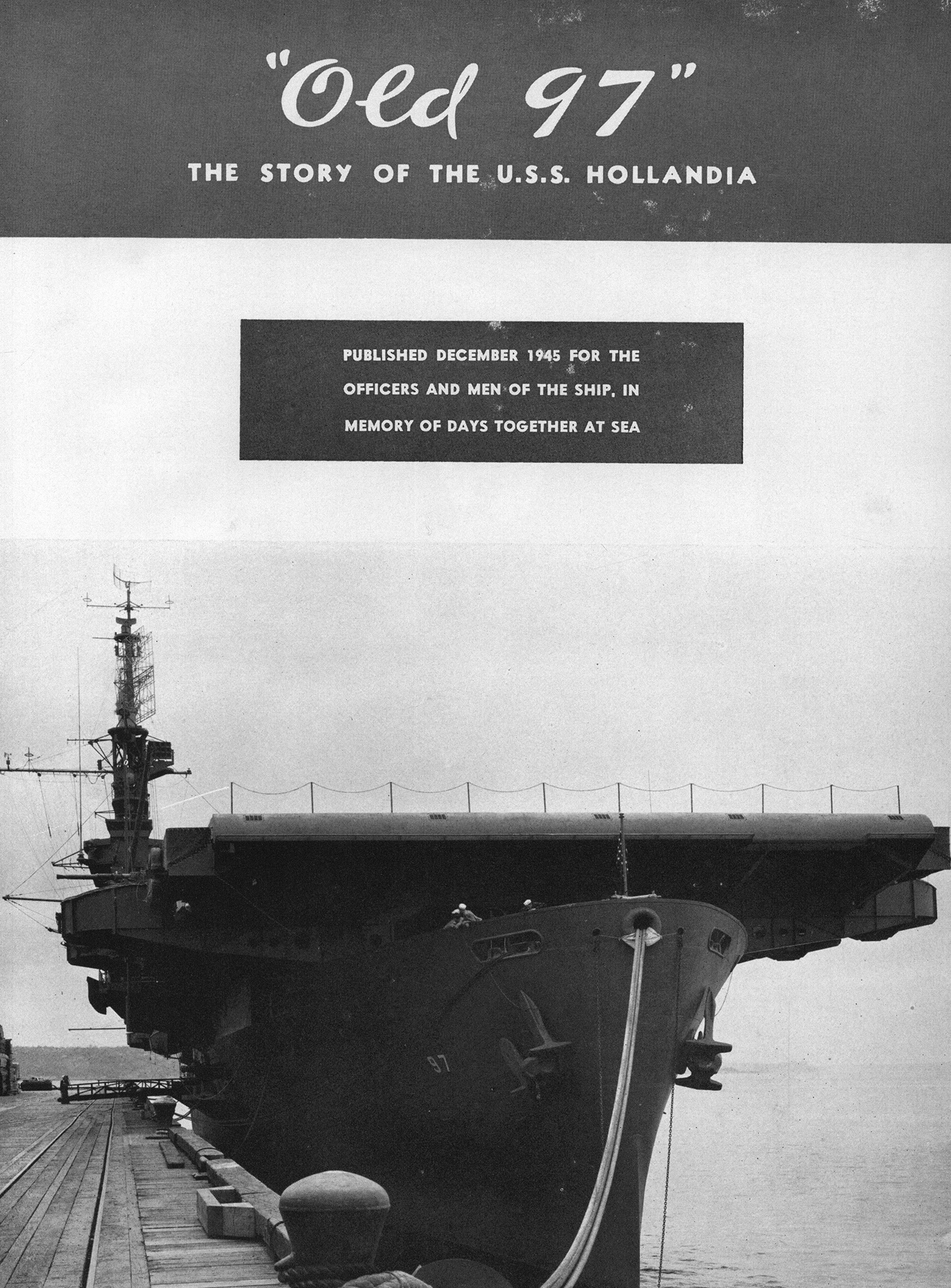
The ship was launched as Astrolabe Bay. Two days before she was commissioned, the Navy renamed her Hollandia, for a recent battle in New Guinea. She was commissioned on June 1, 1944, at Astoria, Oregon. Her crew called her Old 97.
Most of the men aboard had never been to sea. When she sailed for the South Pacific in July, not one of her deck watch officers was yet qualified for the job. Joe had spent eighteen months on a cruiser and had been through Sicily and the torpedo at Bougainville. He was given charge of the division that ran the main engines.
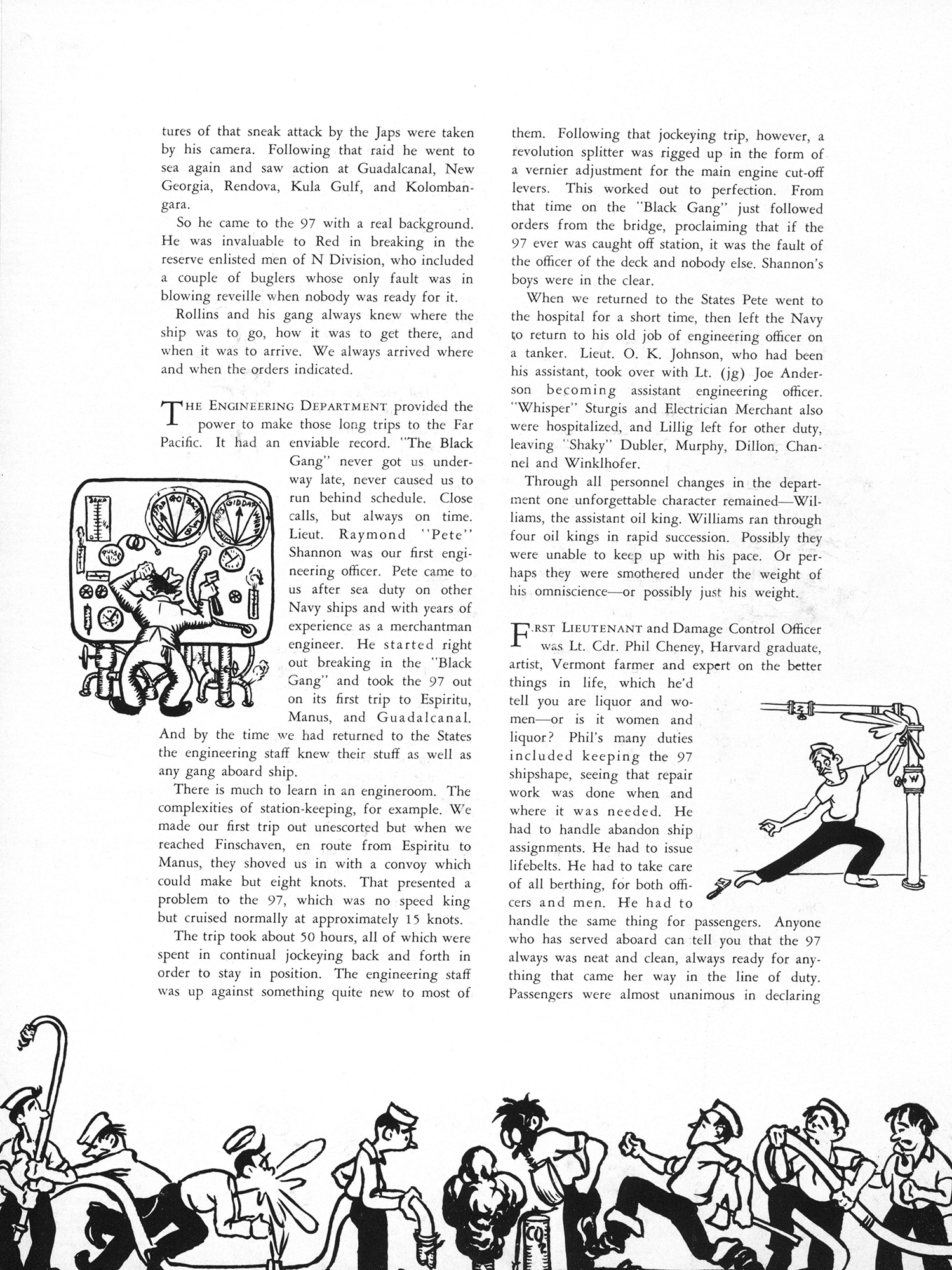
On that first trip out, the ship was ordered to keep station in a convoy that could make only eight knots. Hollandia normally cruised at fifteen. For about fifty hours the engine room had to slow and speed up, over and over, to hold position. The ship’s history says it was something new to most of the engineering staff. After that trip they rigged a fine adjustment on the main engine controls, and from then on, the engine room held station to the bridge’s orders. When the ship returned to the States in August, her chief engineer left the Navy. His assistant moved up, and Lieutenant (junior grade) Joe Anderson became assistant engineering officer.
October 16
Ben was killed outside Brest, France, on September 5, 1944.
Hollandia reached the new fleet base at Manus, in the Admiralty Islands, on October 10. The harbor was full of warships. The Third Fleet was about to sail for the invasion of Leyte. Hollandia, which carried replacement planes and supplies, unloaded and left on the 12th for Pearl Harbor by way of Majuro, in the Marshall Islands.
October 16 was Joe’s 27th birthday. He spent it at sea, somewhere between Manus and Majuro. That day he wrote a letter about his brother. In it he said that if he lived and came home to Edgefield after the war, he would try hard to carry on for Ben and himself. That letter, or a copy of it, was given to Clemson University by his grandson, Fletcher Anderson, class of 2004. You can read it here.
Chief Engineer
In February 1945 his commanding officer, Captain Charles L. Lee, wrote that Lieutenant Anderson was well qualified as chief engineer for escort carrier plants.
In April Hollandia took Marine fighter pilots to Okinawa and flew them off, sixty miles from shore, to land on the island’s airstrips. A Japanese suicide plane had gone after the first two carriers to make the run. That summer she carried replacement planes and pilots to Admiral Halsey’s carriers off the coast of Japan, and she was off Honshu when the war ended.
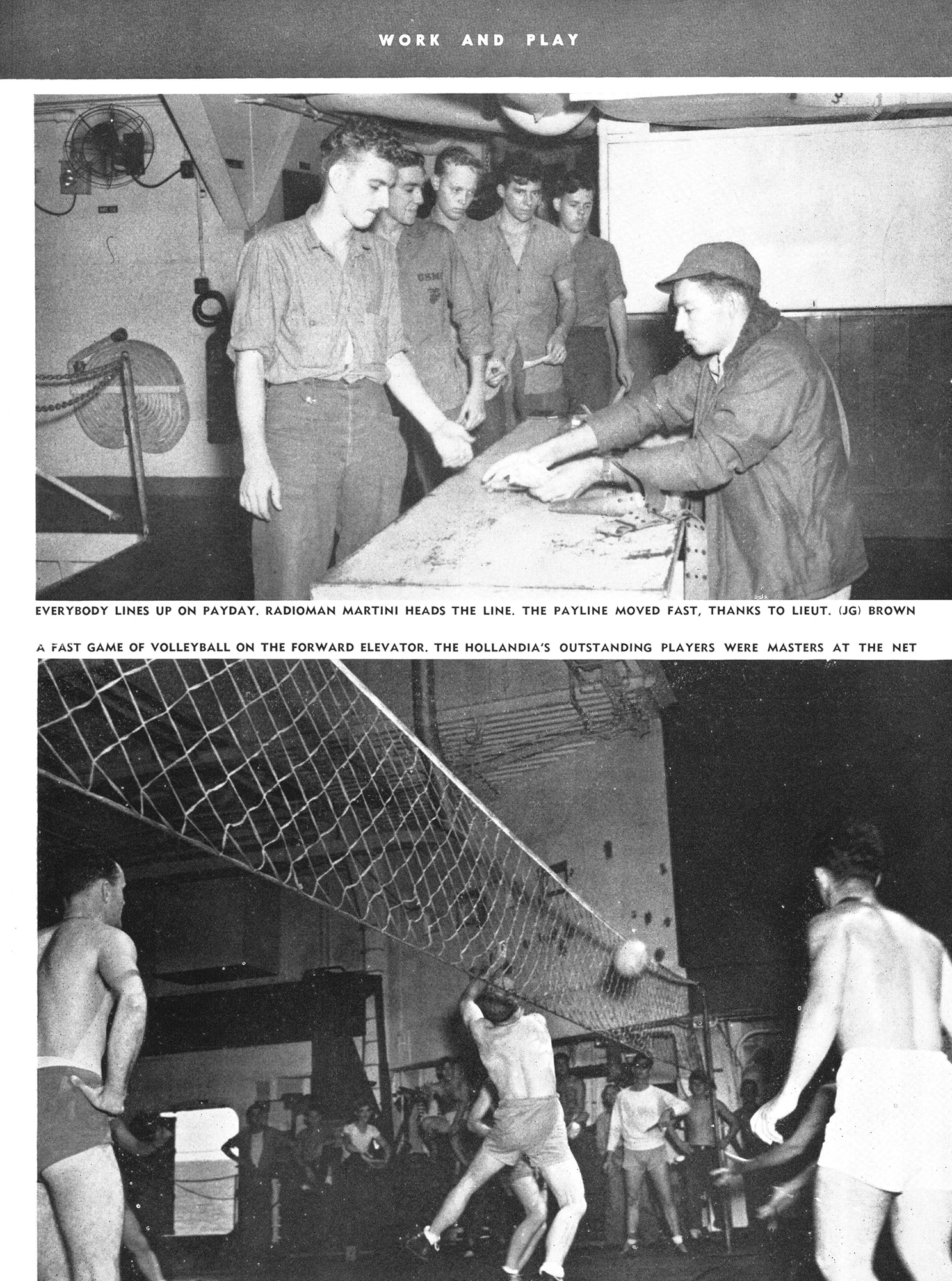
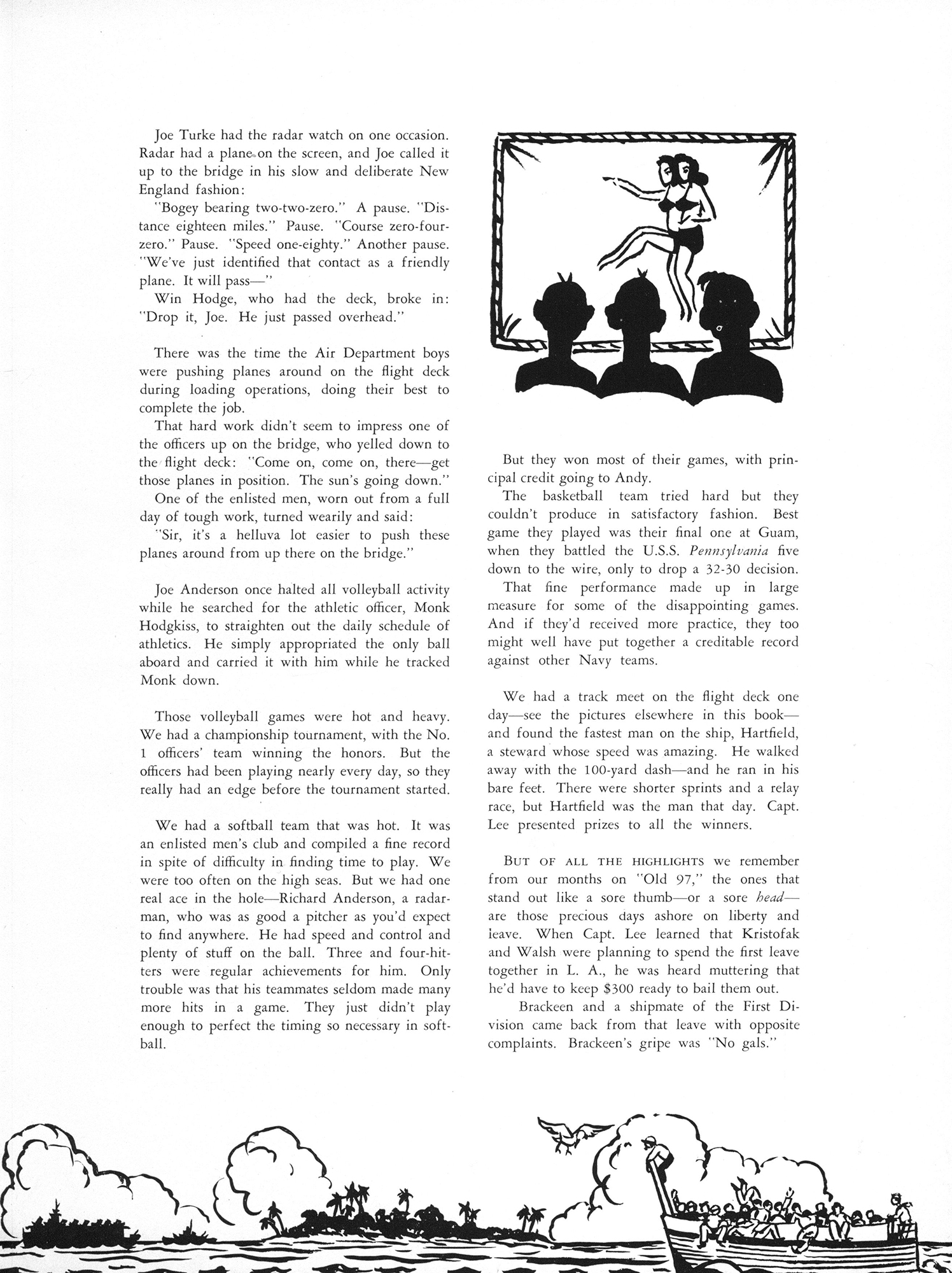
The ship’s history kept one story about him. Joe once halted all volleyball on the ship while he went looking for the athletic officer, Monk Hodgkiss, to straighten out the daily athletics schedule. He did it by taking the only ball aboard and carrying it with him until he found him.
The war was over. Men with enough service were going home, and Joe was eligible. On September 17, 1945, he wrote to the Bureau of Naval Personnel and asked to stay on active duty until December 15. His captain forwarded the request with a note: Lieutenant Anderson will become Chief Engineer of this vessel upon the detachment for separation of the present Chief Engineer.
On October 8 he took over the engineering department of Old 97. The ship had been fitted out with bunks on the hangar deck, and for the rest of the year she carried servicemen home. On November 29 she came into Alameda, California, with 1,100 men from Eniwetok and Kwajalein.
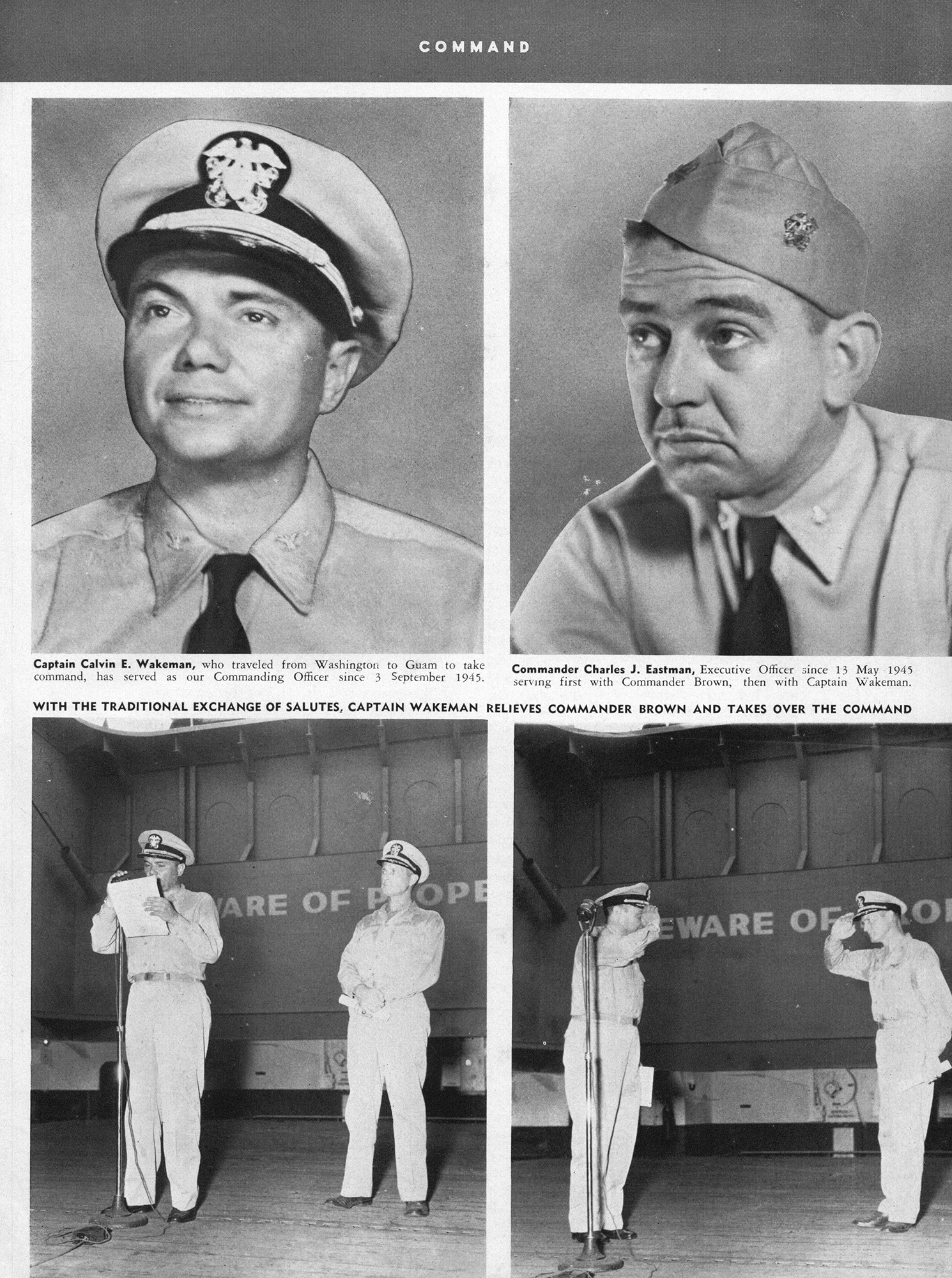
On December 15, 1945, Captain Calvin E. Wakeman wrote his last fitness report:
Lieutenant Anderson is a quiet unassuming officer, with a pleasant affable personality masking a driving force and energy. He accomplishes his ends with effortless ease. Outstanding performance of regular and additional duties. He organizes his work exceptionally well and follows through with vigor.
Lieutenant Anderson’s separation from the service is a distinct loss to the Navy and this ship.
On the line for his next duty preference, sea or shore, Joe wrote: None.
Sources
- Official Military Personnel File, Lt. Joseph Fletcher Anderson, USNR, National Personnel Records Center (fitness reports 1942–1945; statements of February 1944 and 1943; orders, birth affidavit, character references, beneficiary records, and correspondence)
- “Old 97”: The Story of the U.S.S. Hollandia, cruise book, 1945 (Lt. Arthur C. Walsh; illustrations by Lt. Cdr. Philip L. Cheney)
- Naval History and Heritage Command, USS Birmingham (CL-62) War Damage Report No. 48
- Dictionary of American Naval Fighting Ships, entries for Birmingham (CL-62) and Hollandia (CVE-97)
- Encyclopedia of Alabama, “USS Birmingham (CL-62)”
- Joseph F. Anderson letter, October 16, 1944, Clemson University Scroll of Honor (Benjamin Waldrep Anderson)
- South Carolina Senate Resolution 811 (2005), Carmen Wilkerson Anderson
PHOTO CREDITS
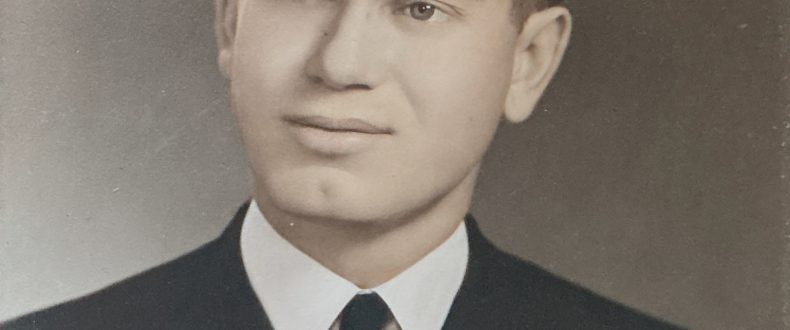
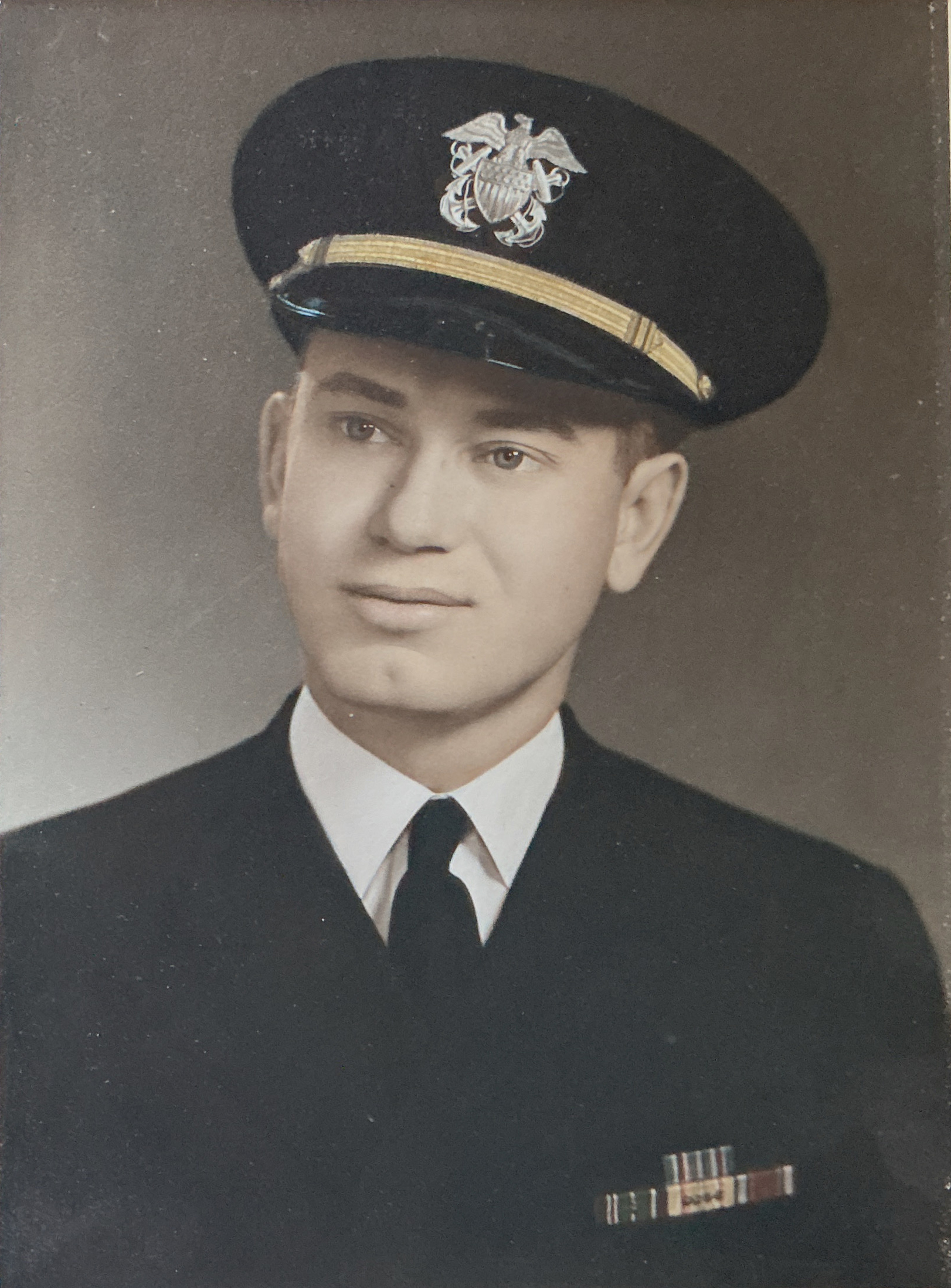
- Joseph Fletcher Anderson, U.S. Naval Reserve. Photo courtesy of his son, Greg Anderson. Used by permission.
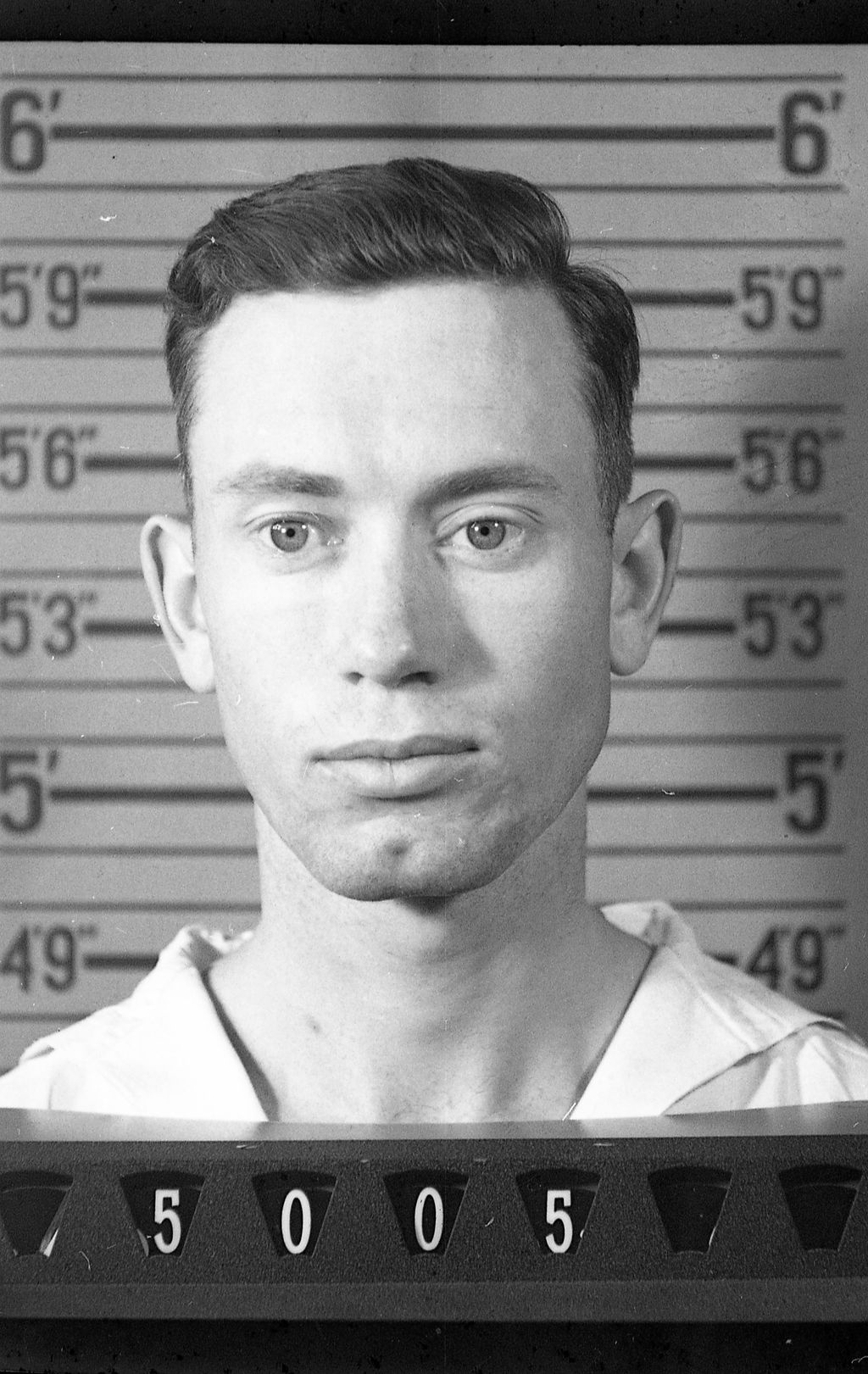
- Joseph F. Anderson in 1942, the year he was commissioned. From his Official Military Personnel File, National Personnel Records Center.
- The title page of “Old 97”: The Story of the U.S.S. Hollandia, published in December 1945 “for the officers and men of the ship, in memory of days together at sea.” Official U.S. Navy photograph.
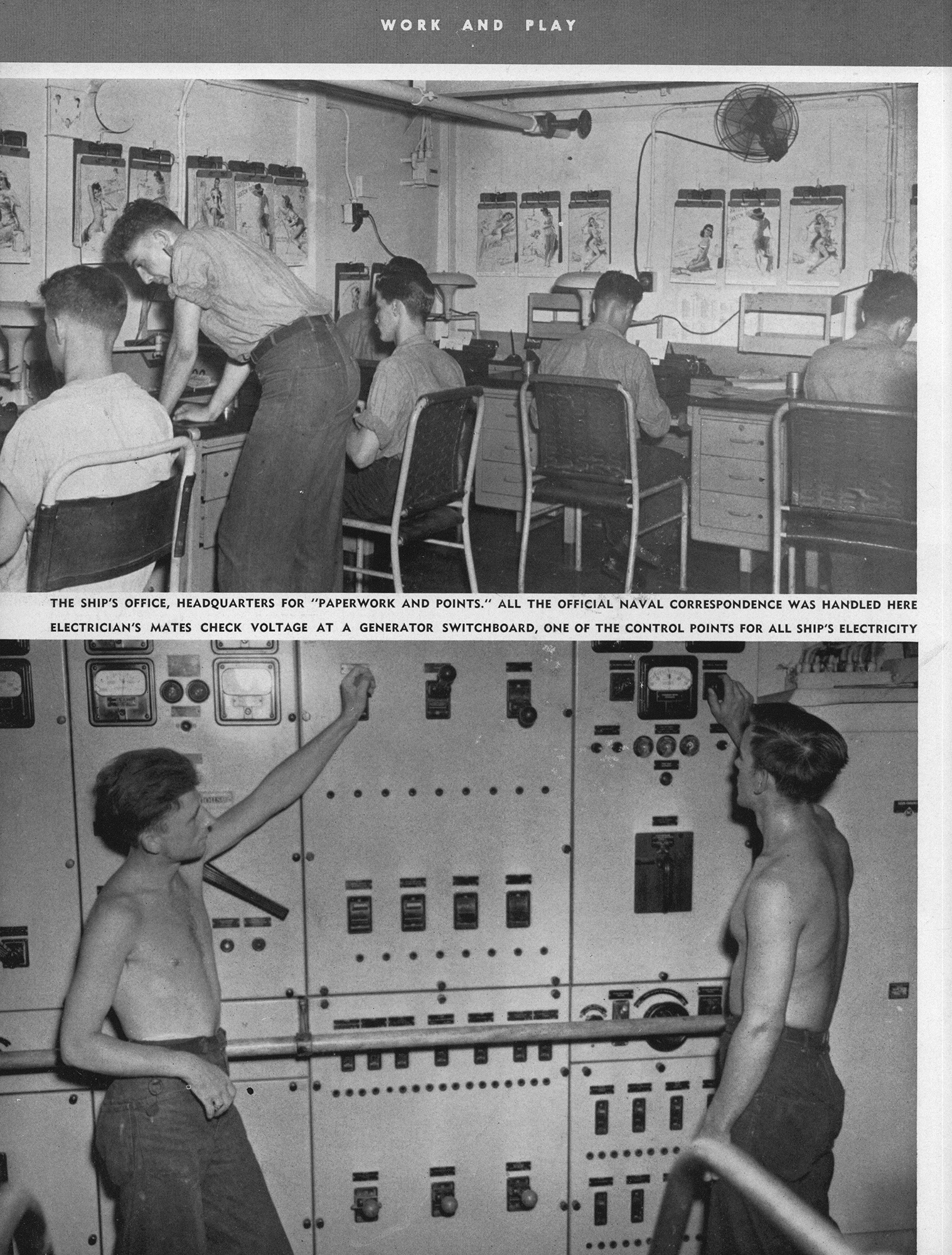
- Top: the ship’s office, “headquarters for paperwork and points,” where all official correspondence was handled. Bottom: electrician’s mates check voltage at a generator switchboard. The ship’s electrical plant was part of the engineering department. Official U.S. Navy photographs, “Old 97” (1945).
- From the ship’s history: the engineering department, “the Black Gang,” and Lt. (jg) Joe Anderson’s move up to assistant engineering officer after Hollandia’s first cruise. Text by Lt. Arthur C. Walsh; illustrations by Lt. Cdr. Philip L. Cheney, “Old 97” (1945).
- Top: payday, with Radioman Martini at the head of the line. Bottom: a volleyball game on the forward elevator. Joe Anderson once stopped every game on the ship by taking the only ball aboard. Official U.S. Navy photographs, “Old 97” (1945).
- Captain Calvin E. Wakeman (top left) took command at Guam in September 1945. That December he wrote Lt. Joe Anderson’s final fitness report. Official U.S. Navy photographs, “Old 97” (1945).
- Official U.S. Navy photographs and illustrations from “Old 97”: The Story of the U.S.S. Hollandia (1945). Cruise book courtesy of Navysite.de.
Five From the 464th Bomb Group
The 15th Army Air Force, based in...Wee Willie and the photo that started it all
Above is B-17 “Wee Willie”...From Panatella to Ploesti
The 15th Army Air Force, based in...Six B-24s From Baker Box Downed
The men – the boys, really...Debut for Debach
It was the very first combat mission...The World War II Dead of University of California at Los Angeles (UCLA)
More than 260 UCLA students, faculty ...


Request Sea Duty Only | Lt. Joseph F. Anderson
On December 13, 1941, six days after...SSGT Morris Meyers: The Man My Dad Never Stopped Waiting For
SSGT Morris Meyers | The Man My Dad...TEC5 Genaro A. Caruso — What the Records Don’t Tell Us
(Troop C, 25th Cavalry Reconnaissance...Nicasio C. Sifuentes: One Week at the Front
(Company A, 10th Armored Infantry...PFC Oscar B. Oakman: The Last Man to Die in the 94th Armored Field Artillery Battalion
(PFC Oscar B. Oakman, 4th Armored...The 4th Armored Division: The Spearhead of Patton’s Third Army
Activated in April 1941 at Pine Camp,...


LOST B-25 “El Aguila” (“The Eagle”) With Crew and Passengers
Hi Georgia: So sorry for this slow response. I'd love to connect with you some time. I suspect that there is information on your great-uncle that is unknown to you. Rather than write up a lengthy e-mail, I suggest that we get on the phone for a brief discussion of our research options. Please use this link: https://calendly.com/ww2research/30min to my calendar to schedule a phone meeting. There is no cost for this research consultation with me; I look forward to talking with you. Best regards, BillSix B-24s From Baker Box Downed
Hello April: Sorry for this slow response. I'd be happy to trade some history with you. You can reach me at bill.beigel@ww2research.com. I might even be able to locate some information that is new to you. Best, BillFive From the 464th Bomb Group
Hi Janice: I apologize for my late replay to your note! We can certainly re-create your father's service with the 454th Bomb Group. Rather than write up a lengthy e-mail, I suggest that we get on the phone for a brief discussion of our research options. Please use this link: https://calendly.com/ww2research/30min to my calendar to schedule a phone meeting. There is no cost for this research consultation with me; I look forward to talking with you. Best regards, BillThe Murder of WAC Private Byrl Babcock
I agree with Vanessa. This is such a compelling story and so well written. It really packed a punch to read that she didn’t return to her base after her leave ended… there was no answer at the hotel room… she and her husband both died of gunshot wounds…Lt. Ecke personally accompanied Byrl’s casket on the journey to CA, stood as honor guard during the funeral, and presented the flag to Byrl’s mother. I loved learning that her headstone did NOT have the last name of her abusive husband who murdered her! I am very curious now to look at WW2 memorials to see if I can find any women’s names listed. It never occurred to me to look before.SSGT Morris Meyers: The Man My Dad Never Stopped Waiting For
So you know how I feel about my cousin, 2Lt A.D. (Alvis Deryl) Noble, I know that he was born on my grandfather's farm in Hopkins Co. Texas, where my father and his and 5 other brothers and 4 sisters were born, then the next information I have is the casualty report after his death as his records were lost in the St. Louis fire. I was born in 1956, 12 years after his death. But I want to thank you once again for your help with what I do know about 2Lt Noble. Sincerely A .D. ( Alan Dale ) NobleSSGT Morris Meyers: The Man My Dad Never Stopped Waiting For
WOW. Great job Something like that for the crew of the B2 nine Salvo Sally that bombed Masaki yes Japan on April 28, 1945. The flight engineer Fred MacDonald was my first cousin husband. The plane went in the ocean. Most likely the gunners are got out and got in parachutes, but only one survived and I found him in St. Louis Missouri Japan held a huge memorial for the crew on April 28, 2018. The survivor was Jack B Cannon. He died. I think he was 94.
Bill’s WWII Almanac









Ask Bill or comment on this story