
The 4th Armored Division: The Spearhead of Patton’s Third Army
Activated in April 1941 at Pine Camp, New York, the 4th Armored Division began with only a handful of soldiers and grew quickly as America prepared for war. After completing large-scale maneuvers in Tennessee and advanced desert training in California, the division sailed for England in early 1944 as part of General George S. Patton’s new Third Army.
The 4th would soon become one of Patton’s most celebrated units—fast, aggressive, decisive, and repeatedly placed at the tip of Third Army’s spear. Their combination of tank, armored infantry, artillery, and reconnaissance units formed a mobile force capable of sustained, rapid offensives across difficult terrain.
Breakout from Normandy and the Drive Across France
Landing on Utah Beach in July 1944, the 4th Armored moved into action during the breakout from Normandy. In August, they fought through Avranches and helped seal the German retreat from Brittany.
Through the fall of 1944, the division advanced across France and into the Lorraine region, engaging in fierce fighting around Arracourt, Lunéville, and Metz. Many of their principal combat elements—
• 37th Tank Battalion,
• 10th Armored Infantry Battalion,
• 94th Armored Field Artillery Battalion, and
• 25th Cavalry Reconnaissance Squadron
—would earn a reputation for speed and striking power that made the 4th Armored one of Patton’s favorite divisions.
Bastogne: The Division’s Most Famous Action
In December 1944, as the Germans launched their surprise Ardennes Offensive, the 4th Armored was ordered north toward Belgium. Patton tasked the division with a historic mission: break through and relieve the troops of the surrounded 101st Airborne Division in Bastogne.
Despite snow, ice, fog, and entrenched German resistance, the division pushed forward mile by mile. On December 26, 1944, tanks of the 37th Tank Battalion reached the southern edge of Bastogne—the first Allied unit to enter the city and break the siege. Fighting continued for days as attached infantry and armored infantry cleared German positions around the perimeter.
This action remains one of the division’s defining moments of the war.
The Final Push Into Germany
In 1945, the 4th Armored crossed the Rhine, swept across central Germany, and pushed into Czechoslovakia, where they ended the war in early May. Their final combat fatality occurred on May 3, 1945, just days before Germany’s surrender.
By the end of the war, the division had earned:
• Five campaign streamers (Normandy, Northern France, Ardennes-Alsace, Rhineland, Central Europe)
• Numerous unit commendations
• A lasting reputation as one of the U.S. Army’s most effective armored divisions
Photo Gallery
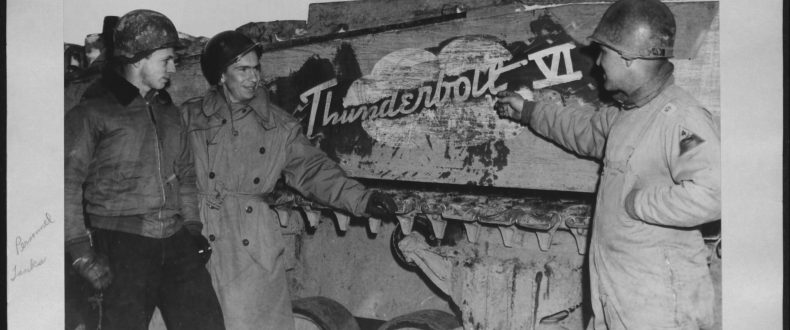
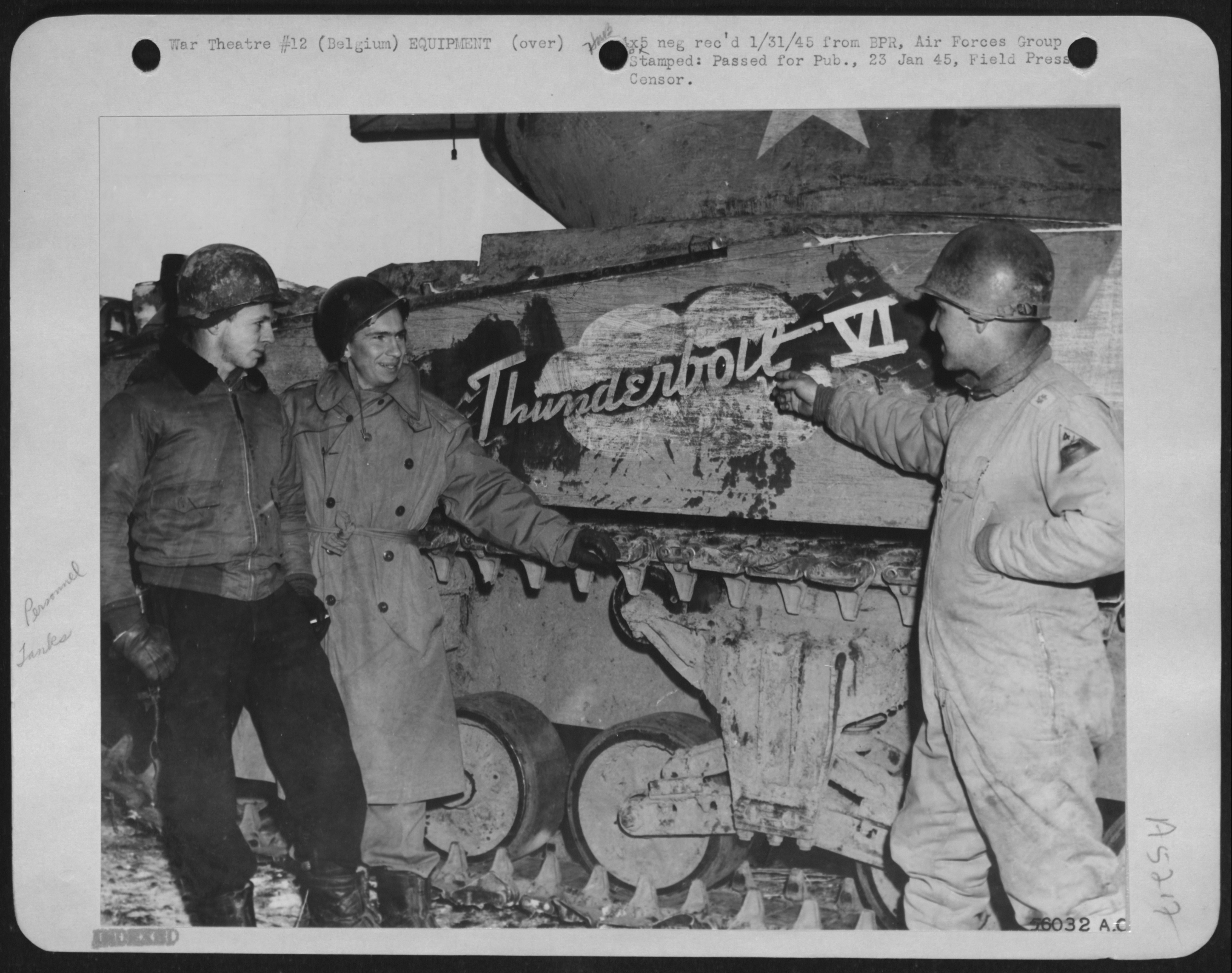
Photo 1 — Abrams tank “Thunderbolt VI”
Lt. Col. Creighton Abrams (right), commander of the 37th Tank Battalion, 4th Armored Division, points to the name “Thunderbolt VI” on his Sherman tank after the breakthrough to Bastogne, Belgium. Capt. McIntire and Capt. Brueland stand with him. January 1945.
U.S. Army Air Forces / National Archives (53032AC).
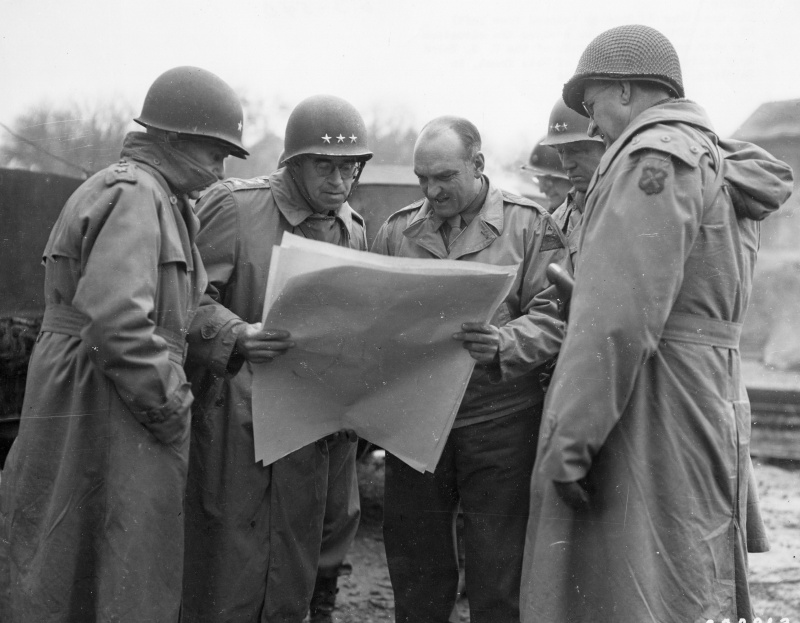
Photo 2 — Generals at Metz
General Omar Bradley (second from left) studies a situation map with senior commanders near Metz, Germany: General Leven Allen (12th Army Group), General John S. Wood (Commanding General, 4th Armored Division), General George S. Patton (Commanding General, Third Army), and General Manton S. Eddy (Commanding General, XII Corps). November 13, 1944.
U.S. Army / National Archives (63-540).
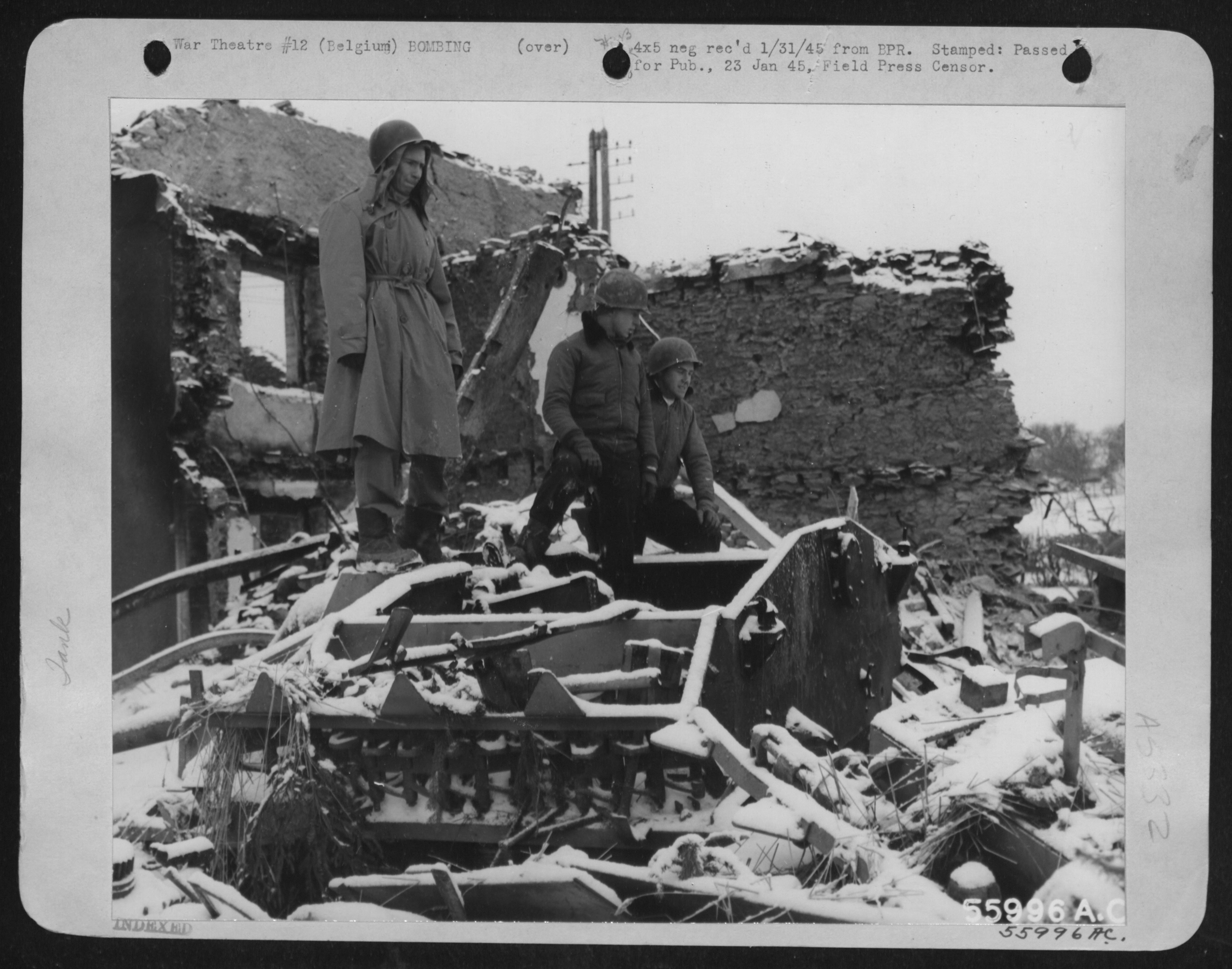
Photo 3 — Destroyed Tiger tank in Belgium
U.S. troops inspect a knocked-out German Tiger tank that had blocked 4th Armored Division tanks in a Belgian village until destroyed by two 500-lb bombs from Republic P-47 Thunderbolts. January 1945.
U.S. Army Air Forces / National Archives (55996AC).
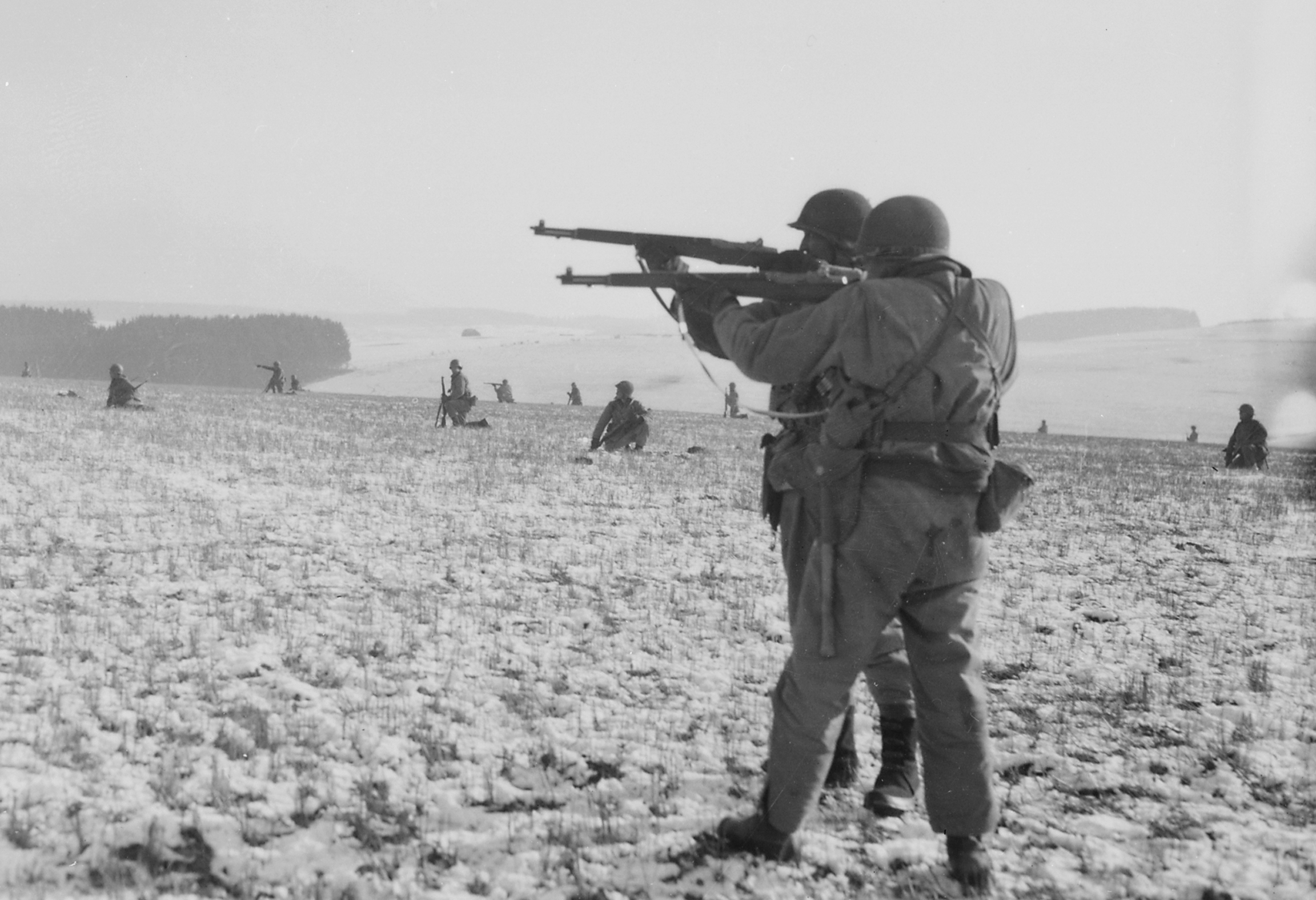
Photo 4 — Advancing infantry near Bastogne
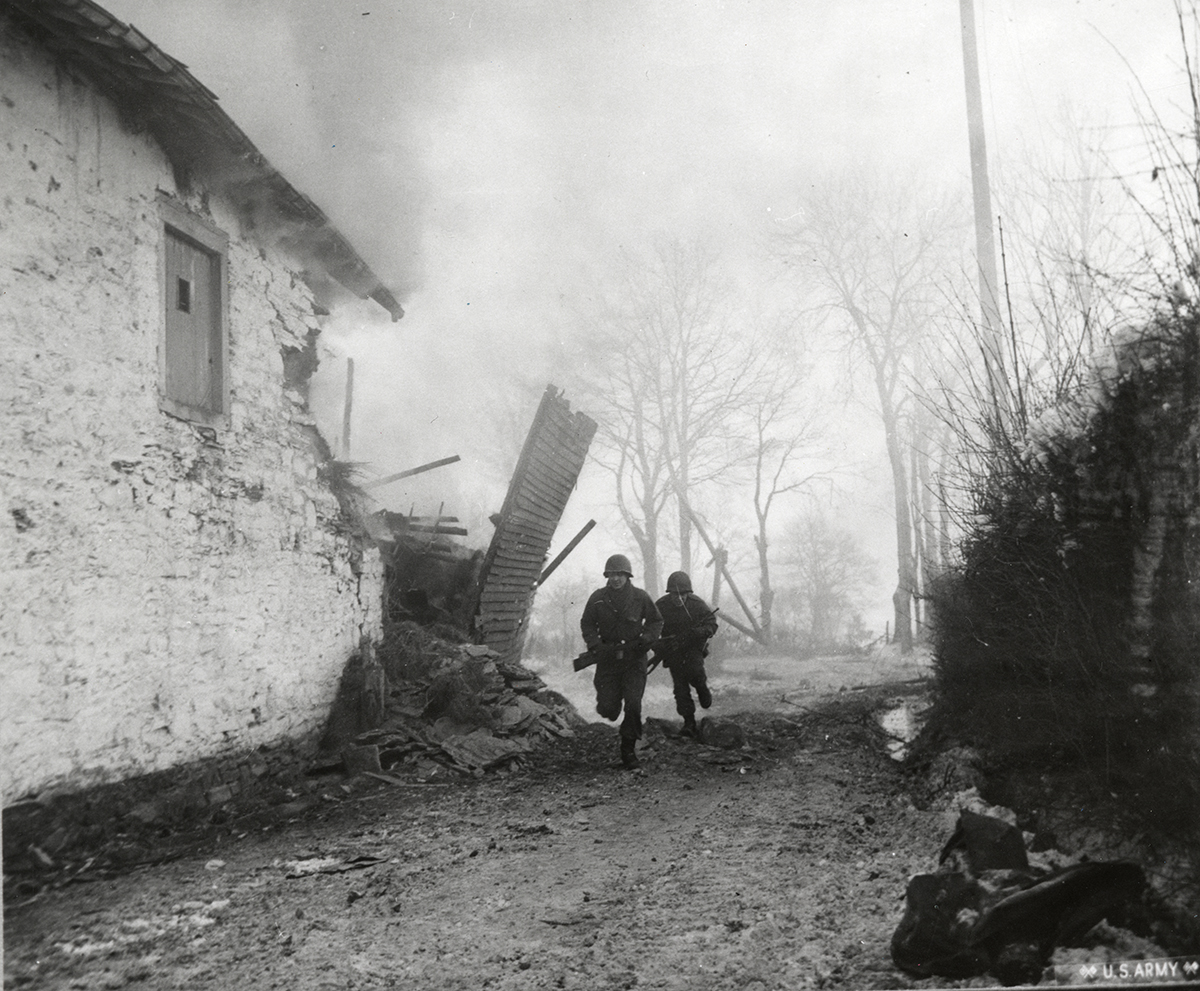
Infantrymen attached to the 4th Armored Division fire on German positions during the advance to relieve encircled airborne troops in Bastogne, Belgium. December 27, 1944.
U.S. Army Signal Corps / National Archives (111-SC-199295).
Four Men of the 4th Armored Division
For more reading on this incredible fighting unit, here are stories of four men I’ve researched from the 4th Armored Division:
- PFC Oscar B. Oakman, Battery A, 94th Armored Field Artillery Battalion: “The Last Man to Die”
- Private Nicasio C. Sifuentes, 10th Armored Infantry Battalion (COMING SOON)
- TEC5 Genaro A. Caruso, Troop C, 25th Cavalry Reconnaissance Squadron (COMING SOON)
- Technical Sergeant Samuel K. English, Platoon Sergeant (MOS 651), Camp Kilmer, NJ (COMING SOON)
Five From the 464th Bomb Group
The 15th Army Air Force, based in...Wee Willie and the photo that started it all
Above is B-17 “Wee Willie”...From Panatella to Ploesti
The 15th Army Air Force, based in...Debut for Debach
It was the very first combat mission...Six B-24s From Baker Box Downed
The men – the boys, really...The World War II Dead of University of California at Los Angeles (UCLA)
More than 260 UCLA students, faculty ...


TEC5 Genaro A. Caruso — What the Records Don’t Tell Us
(Troop C, 25th Cavalry Reconnaissance...Nicasio C. Sifuentes: One Week at the Front
(Company A, 10th Armored Infantry...PFC Oscar B. Oakman: The Last Man to Die in the 94th Armored Field Artillery Battalion
(PFC Oscar B. Oakman, 4th Armored...The 4th Armored Division: The Spearhead of Patton’s Third Army
Activated in April 1941 at Pine Camp,...Talk Radio One’s Steven Spierer Interviews WW2 Researcher Bill Beigel
Steven Spierer Talk Radio One Interview...Captain Norman L. Aigner: An Ordinary Guy
If you’ve been reading my blog with...


Captain Norman L. Aigner: An Ordinary Guy
Thank you for your comment! Please tell us a little more about your inquiry at this link https://www.ww2research.com/contact/ and we'll be in touch. Best - Bill BeigelFrom Panatella to Ploesti
Great blog. My late father was a bombardier based out of Panatella. His plane was Jackpine Joe. Worked Ploesti and Germany. See Jackpinejoe.comWee Willie and the photo that started it all
My father was Paul D Jessop, he spoke of your Grandfather a lot. My father passed away in 2011 .Captain Norman L. Aigner: An Ordinary Guy
I'm trying to find out about a veteran who was with the 3rd Infantry under Patton. The only info I have is a basic training image has the unit flag: RTC 207C Infantry Name: James Anderson Foster Jr from NCThe World War II Dead of University of California at Los Angeles (UCLA)
Hi Bill, Thanks for putting this together. My grand uncle, 2nd Lt. Robert L. Woolfolk attended UCLA and I believe he graduated in 1936. He was on the waterpolo team. He was a bombardier in the 571st Bomb Squadron, 390th Bomb Group and his aircraft "Decatur Deb" was shot down on May 28, 1944. He and six others perished while three were able bail out and became POWs. This is written up the in the book "Bloody Skies: U.S. Eighth Air Force Battle Damage in World War II." There is a B-17G tail gunner's compartment on display at the 390th Bomb Group Memorial Museum, which is dedicated to this crew. Regards, Nick VeronicoBill’s WW2 Almanac for January 21: Featuring Col. Randy’s Flying Circus
Hi! Randall Col Randy is actually my great grandfather and I was wandering if you ever new him? I am curious to know more about him.
Bill’s WWII Almanac








Ask Bill or comment on this story