
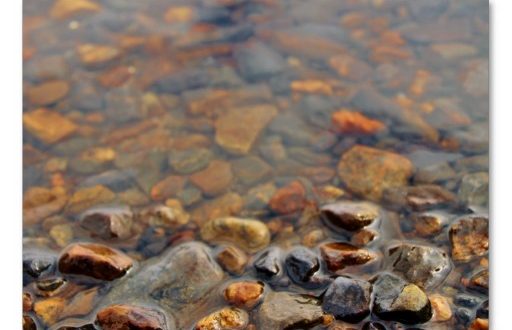
Simmons’ Creek
by Bill Beigel
Walking the beach at dawn is a habit. There are many places where I can find a crescent ring of tiny shells.
The shells are embedded and enmeshed in a tangled mass of sea grass and feathers and dark, coarse sand. They are nearly hidden. But when the sun is just right, the shells shine out to me. I have picked up many handfuls, but usually end up tossing them back into the ocean. I enjoy the small splash they cause, and the ripples that tickle the surface for a few seconds.
The dark sand is carried into the ocean from creeks which start at the palm-covered springs in the mountains. The creek I know the best (my grandfather called it Simmons’ creek) emerges from a sandstone cliff, at the end of a trail, a few hundred feet from the top of a ridge.
When it has been a wet year, the creek bursts forth with so much strength that it erodes the surrounding rock face. It stings when I put my face against the sparkling water, but God, it makes me smile. When I was last there, in the spring, I watched the water pour and pour into the pond, and the water was always clear. How do the rocks that sparkle at the bottom of the pond maintain their place in the sand, and their solidity, their very being, against the onrushing flow?
When it rains in the hills above Simmons’ creek, the water can evaporate and return to the sky, or it can percolate into the bedrock and join the aquifer. Or it can choose to be part of Simmons’ creek. There is more than one path it can take. Nothing is planned in advance.
It only rains in the spring. This spring, it rained in March and early April; after that, not a cloud and not a drop. Now it is late summer and Simmons’ creek is lower than I have ever seen it. That bothers me some. The change from blue and green water to dry rock bed does not meet with my idea of the fitness of things; it does not agree with the way I have been taught and what I have been told. Today, a child can step across the creek, carefully balancing on rocks that have not been dried by the sun for decades. I watched her, and she smiled most of the time, with just one quick look of fear when one of her feet nearly slipped. Then she was on the other side of Simmons’ creek.
This child will learn a different lesson than I have been taught about Simmons’ creek.
Five From the 464th Bomb Group
The 15th Army Air Force, based in...Wee Willie and the photo that started it all
Above is B-17 “Wee Willie”...From Panatella to Ploesti
The 15th Army Air Force, based in...Debut for Debach
It was the very first combat mission...Six B-24s From Baker Box Downed
The men – the boys, really...The World War II Dead of University of California at Los Angeles (UCLA)
More than 260 UCLA students, faculty ...


TEC5 Genaro A. Caruso — What the Records Don’t Tell Us
(Troop C, 25th Cavalry Reconnaissance...Nicasio C. Sifuentes: One Week at the Front
(Company A, 10th Armored Infantry...PFC Oscar B. Oakman: The Last Man to Die in the 94th Armored Field Artillery Battalion
(PFC Oscar B. Oakman, 4th Armored...The 4th Armored Division: The Spearhead of Patton’s Third Army
Activated in April 1941 at Pine Camp,...Talk Radio One’s Steven Spierer Interviews WW2 Researcher Bill Beigel
Steven Spierer Talk Radio One Interview...Captain Norman L. Aigner: An Ordinary Guy
If you’ve been reading my blog with...


Captain Norman L. Aigner: An Ordinary Guy
Thank you for your comment! Please tell us a little more about your inquiry at this link https://www.ww2research.com/contact/ and we'll be in touch. Best - Bill BeigelFrom Panatella to Ploesti
Great blog. My late father was a bombardier based out of Panatella. His plane was Jackpine Joe. Worked Ploesti and Germany. See Jackpinejoe.comWee Willie and the photo that started it all
My father was Paul D Jessop, he spoke of your Grandfather a lot. My father passed away in 2011 .Captain Norman L. Aigner: An Ordinary Guy
I'm trying to find out about a veteran who was with the 3rd Infantry under Patton. The only info I have is a basic training image has the unit flag: RTC 207C Infantry Name: James Anderson Foster Jr from NCThe World War II Dead of University of California at Los Angeles (UCLA)
Hi Bill, Thanks for putting this together. My grand uncle, 2nd Lt. Robert L. Woolfolk attended UCLA and I believe he graduated in 1936. He was on the waterpolo team. He was a bombardier in the 571st Bomb Squadron, 390th Bomb Group and his aircraft "Decatur Deb" was shot down on May 28, 1944. He and six others perished while three were able bail out and became POWs. This is written up the in the book "Bloody Skies: U.S. Eighth Air Force Battle Damage in World War II." There is a B-17G tail gunner's compartment on display at the 390th Bomb Group Memorial Museum, which is dedicated to this crew. Regards, Nick VeronicoBill’s WW2 Almanac for January 21: Featuring Col. Randy’s Flying Circus
Hi! Randall Col Randy is actually my great grandfather and I was wandering if you ever new him? I am curious to know more about him.
Bill’s WWII Almanac










Ask Bill or comment on this story